Introduction: The Freelance Landscape in 2026
The dream of freelance web development is highly appealing: complete autonomy over your schedule, the freedom to work from anywhere in the world, and the ability to choose projects that genuinely excite you.
However, for many developers entering the market in 2026, the reality is a harsh, frustrating uphill battle.
Traditional gig-economy platforms have become hyper-saturated. A single posting for a simple React component or landing page on Upwork or Fiverr can attract over 200 proposals within minutes. Many of these bids are generated by automated bots or low-ball outsourcing agencies willing to work for unsustainable, below-minimum-wage rates.
This race to the bottom has left skilled, professional developers feeling discouraged and undervalued.
But here is the industry's best-kept secret: high-value clients are just as frustrated as you are. They are tired of wading through hundreds of low-quality, AI-generated proposals to find a reliable engineer who actually understands software architecture, security, and performance.
To escape this noise, premium clients and elite developers have migrated to specialized, curated, and unsaturated freelance web developer platforms.
In this guide, we will analyze the 7 best unsaturated freelance platforms in 2026. We will explore their vetting processes, fee structures, and client profiles, and provide you with actionable strategies to secure high-paying, long-term contracts.
The Saturation Problem: Why Upwork and Fiverr are Broken
To understand where the opportunities lie, we must first diagnose why legacy platforms are failing professional developers:
- AI-Generated Proposal Spam: The rise of browser automation and LLM APIs has allowed low-quality agencies to deploy bots that instantly draft and submit highly generic proposals to every new job posting, burying organic bids.
- Pay-to-Play Mechanics: Legacy platforms have heavily monetized the bidding process. Developers must purchase digital tokens ("Connects") simply to submit a proposal, turning freelancing into an expensive lottery.
- Lack of Vetting: By allowing anyone to register without verifying their technical competence, these platforms have degraded client trust. High-budget enterprise clients have largely abandoned them.
Our Selection Criteria for Unsaturated Platforms
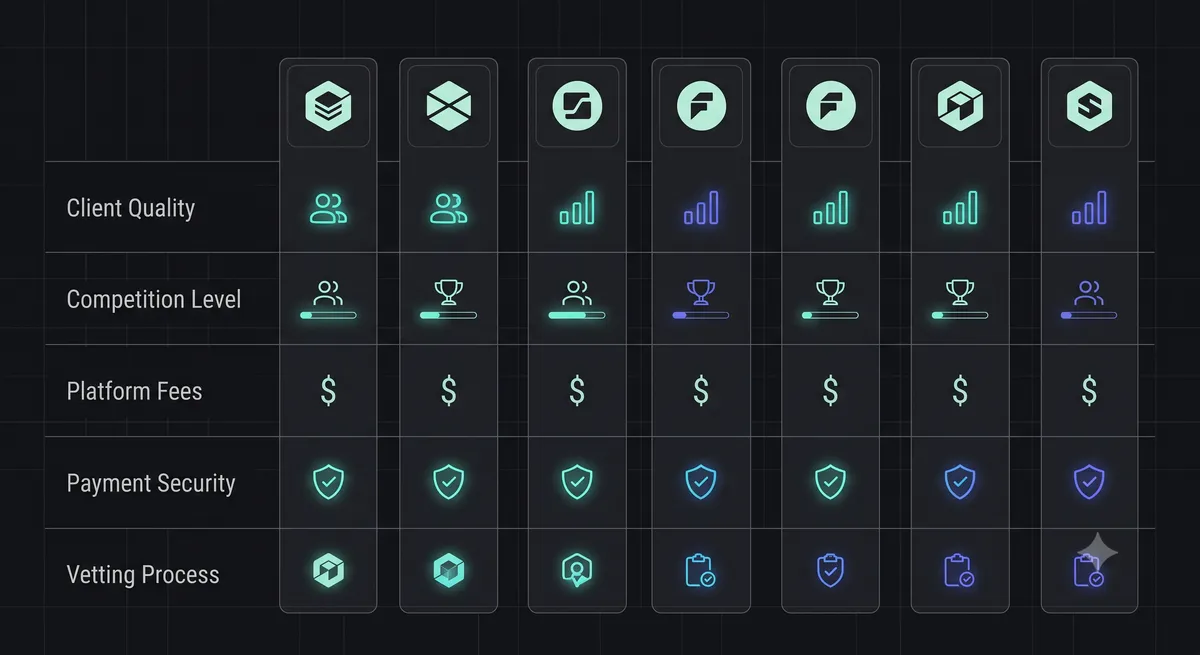
To compile this list of the top 7 platforms, we evaluated dozens of networks against four strict, developer-centric criteria:
- Vetting Barrier: The platform must feature a robust technical or portfolio screening process to filter out low-quality spammers, protecting the talent pool.
- Client Quality & Budget: The average contract value must support professional, sustainable living standards (typically $50–$150+/hour or $5k–$50k+ per project).
- Low Competition-to-Job Ratio: The platform must actively manage its supply of developers to ensure that qualified members receive consistent project invites.
- Fair Fee Structures: The platform must charge reasonable commission rates and feature secure escrow or payment protection.
The 7 Best Unsaturated Freelance Platforms
1. Contra
Contra is a commission-free, independent freelance network designed specifically for the modern digital worker. Unlike legacy platforms that take a 10%–20% cut of your hard-earned money, Contra charges 0% platform fees to freelancers. They monetize via premium subscription tiers for advanced profile features.
Best For: Frontend/Full-Stack Developers with highly visual portfolios (React, Tailwind, Next.js).
2. Wellfound (formerly AngelList Talent)
While widely known as a startup job board, Wellfound features an incredibly powerful, unsaturated freelance and contract marketplace. Startups backed by top-tier venture capital firms use Wellfound to find specialized contractors who can build MVPs or scale features quickly.
Best For: Full-Stack Engineers, AI Integration Specialists, and DevOps Engineers.
3. Gun.io
Gun.io is an elite, developer-first network that matches freelancers with high-growth companies. Instead of a public bidding board, Gun.io's internal team of engineers manually reviews client requirements and personally recommends 2-3 vetted developers from their network, completely eliminating proposal competition.
Best For: Senior Software Engineers, Backend Architects, and Mobile Developers.
4. Lemon.io
Lemon.io acts as an outsourced matchmaker for European and Latin American developers looking to work with US-based startups. They feature a rigorous multi-stage vetting process (including live coding tests), but once accepted, they guarantee matching you with a client within 1-2 weeks.
Best For: Mid-to-Senior React, Node.js, and Python Developers.
5. Braintrust
Braintrust is a decentralized, talent-owned freelance network. Because the platform is governed by its users via a utility token, the platform fees are capped at a flat 10% (paid by the client), meaning developers keep 100% of their billable rate. They attract massive enterprise clients like Nestlé, Porsche, and Nike.
Best For: Enterprise Consultants, Solutions Architects, and Senior Frontend Developers.
6. Y Combinator Work at a Startup
Y Combinator's official directory allows you to filter specifically for contract, freelance, and part-time roles at active YC-funded startups. These clients are highly technical, well-funded, and value engineering speed and execution over low-cost labor.
Best For: Next.js, Supabase, and AI-native developers who can build fast.
7. Toptal
Toptal claims to represent the "top 3% of freelance talent." While their vetting process is notoriously difficult (including portfolio reviews, algorithmic tests, and a live design project), passing the barrier grants you instant access to premium, non-competitive contracts with Fortune 500 companies.
Best For: Elite, highly experienced Software Engineers and Tech Leads.
How to Stand Out: The "Zero-Noise" Profile Method
Even on unsaturated platforms, you must present yourself as a premium, specialized expert. Avoid the common mistake of writing a generic "Full-Stack Developer" profile. Instead, adopt the Zero-Noise Profile Method:
- Niche Down Aggressively: Instead of "I write JavaScript," position yourself as "Next.js & Supabase Performance Specialist for SaaS Startups." Clients pay a massive premium for specialists who can solve their exact problem.
- Showcase Business Outcomes: Do not just list your tech stack. Explain *what* you achieved: "Re-architected a Next.js frontend, slashing Largest Contentful Paint (LCP) by 64% and increasing checkout conversions by 12%."
- Embed Interactive Proof: Include links to fully functional tools or open-source libraries you have built (such as our interactive JSON Formatter or Regex Tester) to instantly prove your engineering capabilities.
Pricing Strategies: Value-Based vs. Hourly
To maximize your freelance revenue, transition away from hourly billing as quickly as possible.
Hourly billing penalizes you for being fast and efficient. If you can build a high-converting landing page in 5 hours using modern AI tools, billing $50/hour only nets you $250.
Instead, utilize Value-Based Pricing:
Value-Based Proposal Example:
"I will design, build, and deploy a custom, high-converting marketing portfolio site styled with Tailwind CSS and optimized for 100% Core Web Vitals using Astro. This includes a CMS integration for your team to easily publish articles, a secure newsletter subscription widget, and a custom interactive tool to engage visitors."
Fixed Project Fee: $4,500
By focusing on the *value* and *outcomes* you deliver to the client's business, you can charge premium rates that reflect your true expertise.
Contract Security & Payment Protection
Never begin working on a freelance project without a signed contract and secure payment terms.
If you are working outside of a platform's built-in escrow system (such as on a direct contract via Contra or Wellfound), enforce these strict guidelines:
- Require a Deposit: Always charge a 50% upfront deposit before writing a single line of code. For larger projects, split payments into weekly or milestone-based deliverables (e.g., 25% on kickoff, 25% on design approval, 25% on staging deployment, 25% on production launch).
- Define Scope Creep: Explicitly list what is *not* included in the project scope. State that additional feature requests will be billed under a separate, hourly change-order agreement.
- Retain Code Ownership: Your contract should state that you retain complete intellectual property ownership of the codebase until the final milestone invoice is paid in full.
Conclusion: Your Path to Freelance Freedom
Freelancing in 2026 is not about competing with millions of low-cost bids on saturated gig boards. It is about positioning yourself as a premium, specialized engineering partner on curated networks that value quality.
By joining unsaturated platforms like Contra, Wellfound, or Gun.io, defining a clear technical niche, and pricing your services based on business value, you can build a highly lucrative, sustainable freelance career.
To build a stunning, high-converting portfolio site that commands premium rates, read our guide on Building a Portfolio with AI, or try our interactive .gitignore Generator to bootstrap your next client repository instantly.