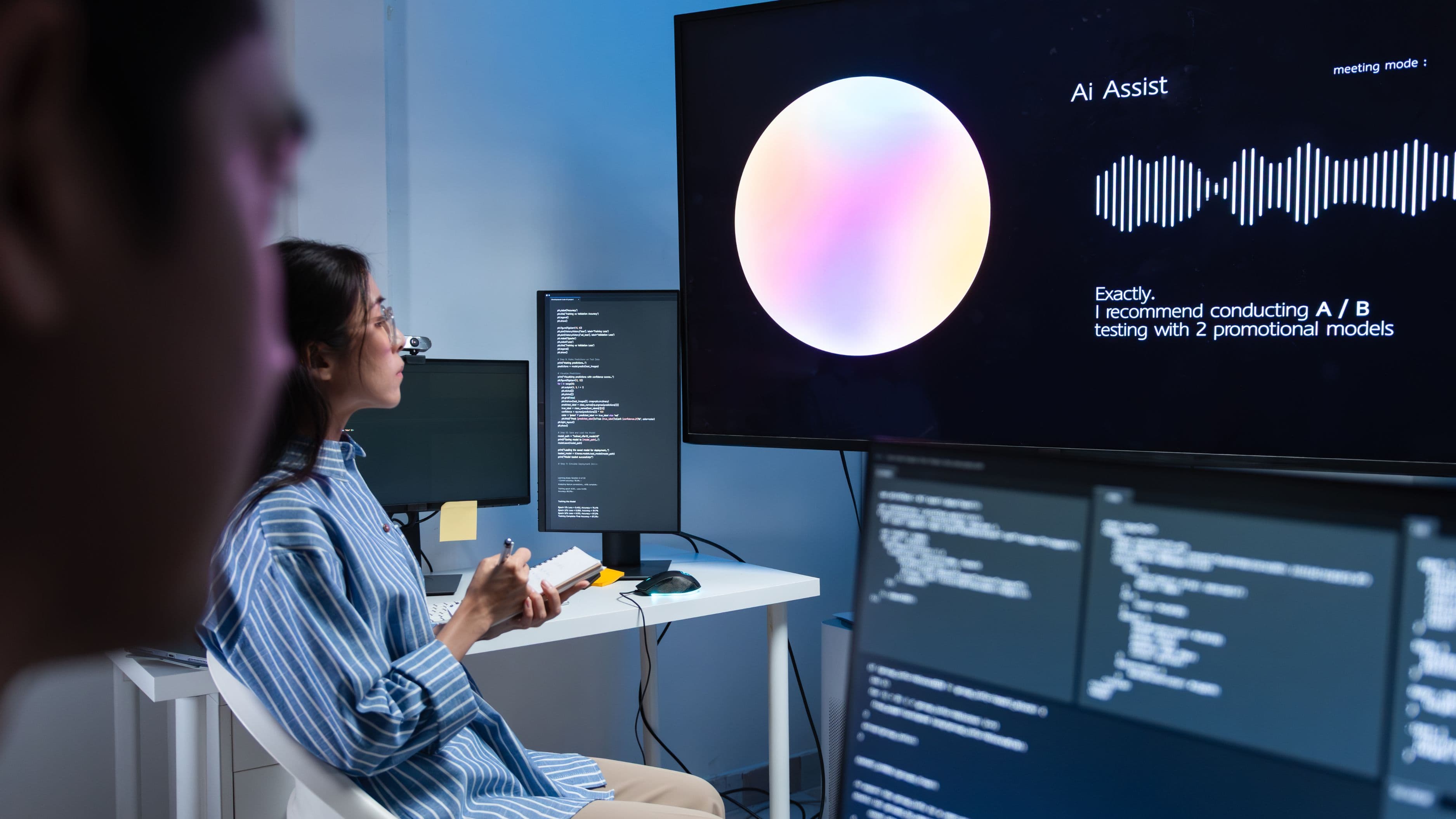
Retrieval-Augmented Generation – RAG, for short – is the architecture that's quietly solving this problem. It's not a new model. It's not a product you can download. It's a design pattern, a way of building systems that combines the language fluency of a large language model with the ability to actually look things up before responding. And it's fast becoming one of the most important ideas in how useful software gets built right now.
If you've used a chatbot that cited sources, a customer support tool that actually knew your order history, or an enterprise search system that answered in plain English instead of returning a list of links – there's a very good chance RAG was involved.
The Problem RAG Is Solving
To understand why RAG matters, it helps to understand what a language model actually does when it answers a question. During training, the model processes enormous quantities of text and learns statistical patterns – which words follow which, how concepts relate to each other, how different kinds of questions tend to be answered. All of that learning gets compressed into the model's parameters: billions of numerical weights that encode its understanding of language and the world.
The catch is that this compressed knowledge has a hard cutoff. The model doesn't know anything that happened after its training data ends. It also doesn't know anything that was never in its training data to begin with – your company's internal policies, a document you wrote last week, a database of customer records, a legal contract that was never published online. For a lot of real-world applications, these are exactly the things you need a system to know about.
The old solution was fine-tuning: taking an existing model and training it further on your specific data. This works, but it's expensive, slow, and doesn't handle information that changes frequently. You can't fine-tune a model every time a new support article gets published or a product price changes. RAG offers a more practical alternative.
How RAG Actually Works
The core idea is straightforward: instead of trying to bake all the relevant information into the model itself, you give the model a way to look things up at query time. When a question comes in, the system first retrieves relevant information from an external source – a document database, a knowledge base, a set of files – and then passes that information to the language model along with the original question. The model generates its response using both its trained knowledge and the freshly retrieved context.
Think of it like the difference between asking someone who studied a topic years ago to answer from memory, versus giving that same person a few relevant pages to read before they respond. The underlying intelligence is the same, but the quality and accuracy of the output changes substantially when there's real, current, specific information to draw from.
The retrieval step is where most of the technical sophistication lives. Modern RAG systems don't search by keywords – they use a technique called semantic search, where both the query and the documents are converted into numerical representations (called embeddings) that capture meaning rather than just matching words. A search for "how do I cancel my subscription" can surface a document titled "Ending your membership" even though none of those words overlap, because the semantic meaning is close enough. This makes retrieval far more useful than traditional search for natural language questions.
Why This Architecture Is Spreading Fast
RAG has become the dominant architecture for a specific reason: it hits the practical sweet spot between capability and maintainability. The language model provides fluency, reasoning, and the ability to synthesize information into coherent answers. The retrieval layer provides freshness, specificity, and grounding in real sources. Neither component alone does what both together can do.
For businesses, this combination solves problems that weren't solvable a few years ago. A legal firm can build a system that answers questions about case law by retrieving from their own database of precedents. A healthcare provider can surface relevant patient history in plain language before a consultation. A software company can power a support chatbot that actually knows the current version of the product documentation, updates and all, without retraining anything. The information lives in documents the organisation already maintains; the model just learns how to read and communicate from them.
There's also a trust dimension worth paying attention to. One of the persistent criticisms of language models is that they generate plausible-sounding text whether or not they actually know what they're talking about – what researchers call hallucination. RAG systems don't eliminate this problem entirely, but they reduce it significantly, because the model's response is anchored to retrieved content rather than relying purely on what it learned during training. When a RAG system is well-designed, it can cite the exact document or passage it drew from, which makes the output verifiable in a way that pure model generation is not.
Where RAG Shows Up in the Real World
The applications are broader than most people realize. Enterprise knowledge management is probably the most common deployment – internal chatbots that answer employee questions by pulling from HR policies, IT documentation, and internal wikis. Instead of searching through a shared drive and reading three different documents, you ask a question and get a direct answer with a reference link.
Customer-facing applications are the next most visible category. Retailers building product recommendation and support tools, SaaS companies powering their help centers with conversational interfaces, financial institutions enabling clients to ask questions about their accounts – all of these increasingly involve some form of RAG under the surface. The experience from the outside is a chatbot that seems to actually know about your specific situation, which is a markedly different experience from the rule-based chatbots of five years ago.
Research and analysis tools are a growing area too. Academic and professional research platforms are building systems that let you ask questions across large corpora of documents – case files, scientific literature, financial reports – and receive synthesized answers with citations. This doesn't replace expert analysis, but it dramatically reduces the time required to orient yourself in a large body of material before the real analytical work begins.
What RAG Still Doesn't Do Well
It's worth being clear about the limitations, because the practical usefulness of any technology depends on understanding where it breaks down. RAG systems are only as good as the retrieval step – if the relevant document isn't in the database, or the semantic search fails to surface it, the model has nothing useful to work with and will either guess or admit it can't help. Garbage in, garbage out applies here just as much as anywhere else.
The quality of the underlying documents matters enormously. A RAG system built on outdated, inconsistent, or poorly organised source material will produce answers that reflect those problems. Organizations sometimes approach RAG as a shortcut around the harder work of maintaining clean, accurate documentation – and they tend to be disappointed with the results.
There's also a context window constraint. Language models can only process a certain amount of text in a single interaction. If the retrieval step surfaces too many lengthy documents, the model can't use all of them effectively. Good RAG engineering involves careful decisions about how much context to retrieve, how to rank and filter results, and how to chunk documents so that the most relevant passages get prioritized.
Why It Matters Beyond the Hype
RAG is not a silver bullet and it's not magic. But it represents a genuinely meaningful shift in how knowledge can be made accessible. The ability to ask a natural language question and receive a grounded, sourced answer from a body of documents – rather than getting a list of links and reading them yourself – changes how quickly people can find and act on information.
For developers and product builders, it opens up a class of applications that previously required either expensive custom NLP work or accepting the limitations of keyword search. For end users, it means interacting with software that actually seems to understand context. And for organizations, it means the knowledge locked in documentation, reports, and internal systems becomes something people can actually query, rather than something they theoretically have access to but practically can't navigate.
The underlying pattern is simple enough that it's being adopted quickly, and complex enough in execution that building it well still requires real skill. That's usually the signature of a technology that sticks around.
FAQ
Is RAG the same as a language model searching the web? Not exactly. Web search integration and RAG both involve retrieving external information, but RAG typically operates over a curated, private dataset rather than the open web. The retrieval is targeted to a specific corpus of documents, which is what makes it useful for domain-specific applications.
Do you need to build RAG yourself, or are there off-the-shelf tools? Both options exist. Frameworks like LangChain and LlamaIndex are specifically built to make RAG systems easier to construct. Cloud providers including AWS, Azure, and Google Cloud offer managed RAG services. There's also a growing ecosystem of no-code and low-code tools aimed at organizations that want to build without deep engineering investment.
Does RAG replace fine-tuning? Not entirely – they solve different problems. Fine-tuning improves how a model behaves and responds to a particular style or domain. RAG improves what information the model has access to at query time. In practice, some advanced systems use both: a fine-tuned model combined with a RAG architecture for knowledge retrieval.
Can RAG systems make things up? Yes, though less frequently than pure model generation when the system is well-designed. The model is still generating text and can deviate from the retrieved content. Good system design – including prompting the model to only draw on provided context and flagging when it can't find relevant information – reduces this significantly but doesn't eliminate it.
📚 Sources
Lewis et al. – Retrieval-Augmented Generation for Knowledge-Intensive NLP Tasks (original RAG paper, Meta AI): https://arxiv.org/abs/2005.11401
IBM – What Is Retrieval-Augmented Generation?: https://research.ibm.com/blog/retrieval-augmented-generation-RAG
LangChain – RAG Documentation and Concepts: https://python.langchain.com/docs/concepts/rag/
LlamaIndex – Introduction to RAG: https://docs.llamaindex.ai/en/stable/getting_started/concepts/
NVIDIA – What Is Retrieval-Augmented Generation?: https://blogs.nvidia.com/blog/what-is-retrieval-augmented-generation/
AWS – Retrieval-Augmented Generation Overview: https://aws.amazon.com/what-is/retrieval-augmented-generation/