Introduction: The Cost of Building a SaaS in 2026
Building a Software-as-a-Service (SaaS) prototype has never been more accessible. With modern frameworks, generative AI assistants, and serverless hosting, a single developer can design and build a functional product in a matter of days.
However, as your application grows, the cost of third-party API integrations can quickly spiral out of control.
Before you have acquired your first paying customer, you might find yourself paying hundreds of dollars a month for user authentication, transactional emails, database hosting, payment gateways, and geolocation lookups.
This financial barrier prevents many developers from ever launching their prototypes.
But here is the truth: you can build and launch a fully functional, production-grade SaaS prototype with zero upfront API costs.
Many of the world's leading developer platforms offer incredibly generous, permanent free-tier APIs. By strategically combining these services, you can construct a robust full-stack backend that scales predictably as your user base grows.
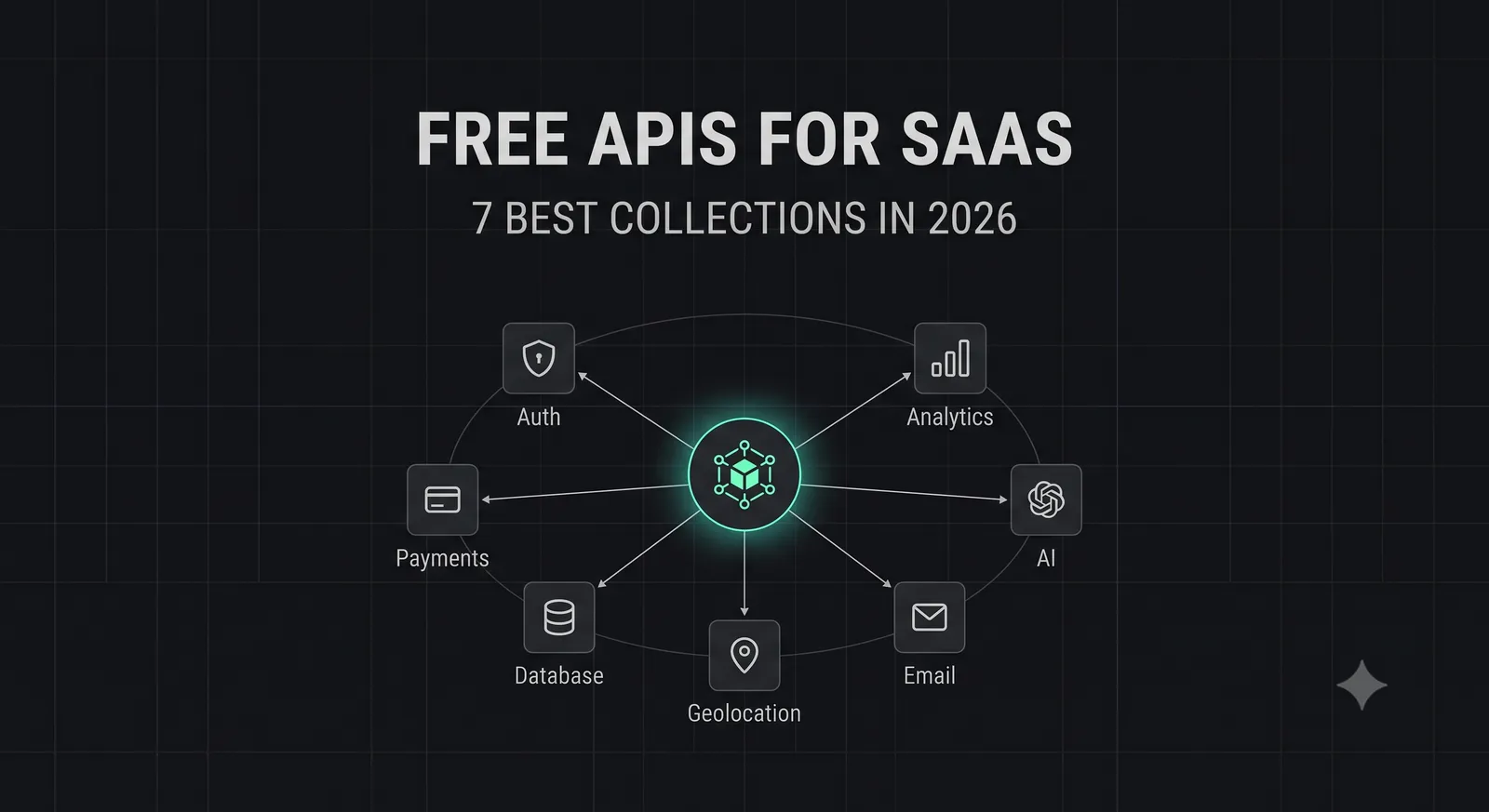
In this guide, we will analyze the 7 best free APIs for SaaS prototypes in 2026. We will explore their features, free-tier limits, and code implementations, and design a serverless SaaS architecture that costs $0/month to run.
The Bootstrap Challenge: Avoiding the Subscription Trap
When building a prototype, your goal is to validate your product-market fit as quickly and cheaply as possible.
Many API providers utilize "dark patterns" in their pricing models: they offer a tiny free tier that is easily exceeded, followed by an immediate jump to a $100+/month enterprise plan.
To avoid this subscription trap, your prototype's API stack must meet three criteria:
- Generous Permanent Free Tier: The free tier must support a realistic number of active users (typically 1,000+ monthly active users) without requiring a credit card.
- Predictable Pay-As-You-Go Scaling: When you eventually exceed the free tier, the pricing must scale linearly based on usage, rather than forcing you into a massive flat-rate plan.
- Standardized Protocols: The APIs must use standard web protocols (REST, GraphQL, or WebSockets) so you can easily swap providers if necessary.
The 7 Best Free APIs for SaaS Prototypes
1. Clerk (User Authentication)
Clerk is the premier user authentication and management API for modern web frameworks. It handles secure login flows, multi-factor authentication (MFA), social logins, and user profile components out of the box.
Free Tier Limit: Up to 10,000 Monthly Active Users (MAUs) completely free, with no credit card required.
2. Supabase (Database & Real-Time)
Supabase is an open-source Firebase alternative built on top of PostgreSQL. It provides a fully managed, high-performance relational database, instant REST APIs, file storage, and real-time websocket listeners.
Free Tier Limit: 2 free PostgreSQL databases with 500MB of storage, 5GB of bandwidth, and up to 50,000 monthly active users.
3. Resend (Transactional Emails)
Resend is a developer-first email API designed for clean, modern transactional emails (such as welcome emails, password resets, and invoices) utilizing React Email templates.
Free Tier Limit: 3,000 emails per month (100 emails per day) using your custom domain.
4. Stripe (Payments & Billing - Test Mode)
Stripe is the gold standard for SaaS subscription billing. While live transactions incur processing fees, Stripe's Test Mode API is 100% free and allows you to build and test complete subscription flows, webhooks, and customer billing portals.
Free Tier Limit: Unlimited free transactions and API calls in Test Mode.
5. Open-Meteo (Weather & Geolocation)
For SaaS applications requiring weather data, map routing, or coordinate lookups, Open-Meteo offers a high-performance, open-source API that requires no API keys and features zero commercial restrictions.
Free Tier Limit: Up to 10,000 API calls per day completely free for non-commercial and commercial prototypes.
6. Logfire (Observability & Monitoring)
Logfire (built by the creators of Pydantic) is a modern, high-performance observability platform. It allows you to monitor your SaaS API endpoints, trace database queries, and track serverless function execution in real-time.
Free Tier Limit: 10 million log/span events per month completely free.
7. OpenRouter (AI & LLM Access)
If your SaaS prototype features AI integrations, OpenRouter provides a single, unified API to access dozens of open-source and proprietary LLMs (such as Llama 3, Mistral, and Claude). They feature a wide collection of high-performance 100% free models.
Free Tier Limit: Unlimited free API calls to their curated list of free models (e.g., meta-llama/llama-3-8b-instruct:free).
Designing a $0/Month Serverless SaaS Architecture
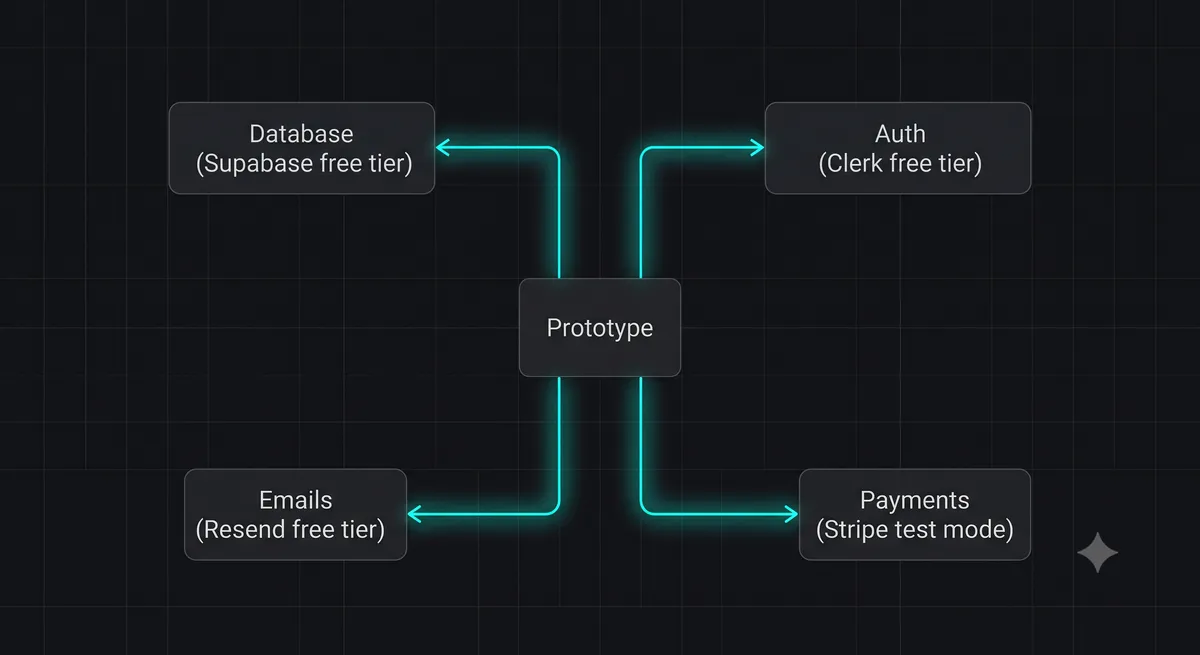
By deploying your application on modern serverless infrastructure, you can host your entire SaaS stack for free:
- Frontend & API Routes: Host your Next.js, Astro, or Remix application on Vercel's Free Tier (includes 100GB of bandwidth and 1 million serverless function executions per month).
- Database: Use Supabase's Free Tier to host your relational PostgreSQL database.
- User Management: Use Clerk to handle user sessions and login components.
- Observability: Use Logfire to monitor error rates and API latency.
Code Implementation: Sending a Free Transactional Email
Let's write a secure Node.js API route to send a transactional welcome email to a new user using the Resend API:
import { Resend } from 'resend';

// Initialize Resend with your free API key
const resend = new Resend(process.env.RESEND_API_KEY);

export async function sendWelcomeEmail(userEmail: string, userName: string) {
  try {
    const data = await resend.emails.send({
      from: 'The Byte 404 ',
      to: [userEmail],
      subject: 'Welcome to your SaaS Prototype!',
      html: `

          Hello, ${userName}!
          Thank you for joining our platform. Your account is now active on our free tier.

          © 2026 The Byte 404. All Rights Reserved.

      `,
    });

    return { success: true, id: data.id };
  } catch (error) {
    console.error('Failed to send email:', error.message);
    return { success: false, error: error.message };
  }
}
Handling Rate Limits on Free-Tier APIs
Because free-tier APIs feature strict rate limits (e.g., Resend's limit of 100 emails per day), your application must implement defensive engineering patterns to prevent service disruptions:
- Implement In-Memory Caching: Cache heavy database queries or geolocation lookups using an in-memory cache (like Upstash Redis free tier) to avoid redundant API calls.
- Queue Heavy Operations: Never execute heavy, non-blocking API calls (like sending emails or triggering webhooks) directly in your main request-response cycle. Queue them using a serverless background task runner (like Ingest free tier).
- Graceful Degradation: If an API call fails due to a rate limit (HTTP Status
429 Too Many Requests), catch the error and gracefully degrade the UI experience (e.g., show a friendly "System busy, please try again in a few minutes" message). Use our interactive HTTP Status Lookup Tool to inspect rate-limit headers.
API Key Security & Environment Variables
Never expose your private API keys in client-side code. If an attacker extracts your Supabase service role key or Resend API key, they can hijack your database or send spam emails under your custom domain.
Enforce these strict security guidelines:
- Always store your keys in a secure
.env.localfile. Read our guide on CLAUDE.md Configurations to learn how to keep secrets out of your repository. - Ensure your
.gitignorefile explicitly blocks.envfiles from being committed to GitHub. Use our interactive .gitignore Generator to bootstrap a secure configuration.
Conclusion: Validate First, Pay Later
The secret to successful SaaS engineering in 2026 is minimizing your financial burn rate while validating your product.
By leveraging the generous free-tier APIs offered by Clerk, Supabase, Resend, and Stripe, you can build, launch, and scale a fully functional SaaS prototype with zero financial risk.
Once your prototype attracts paying customers, you can easily transition to paid tiers, knowing your product has validated market demand.
To secure your database connections before launching your prototype, read our guide on Supabase Auth Session Fixes, or try our interactive JSON Formatter & Validator to structure your API payloads perfectly.